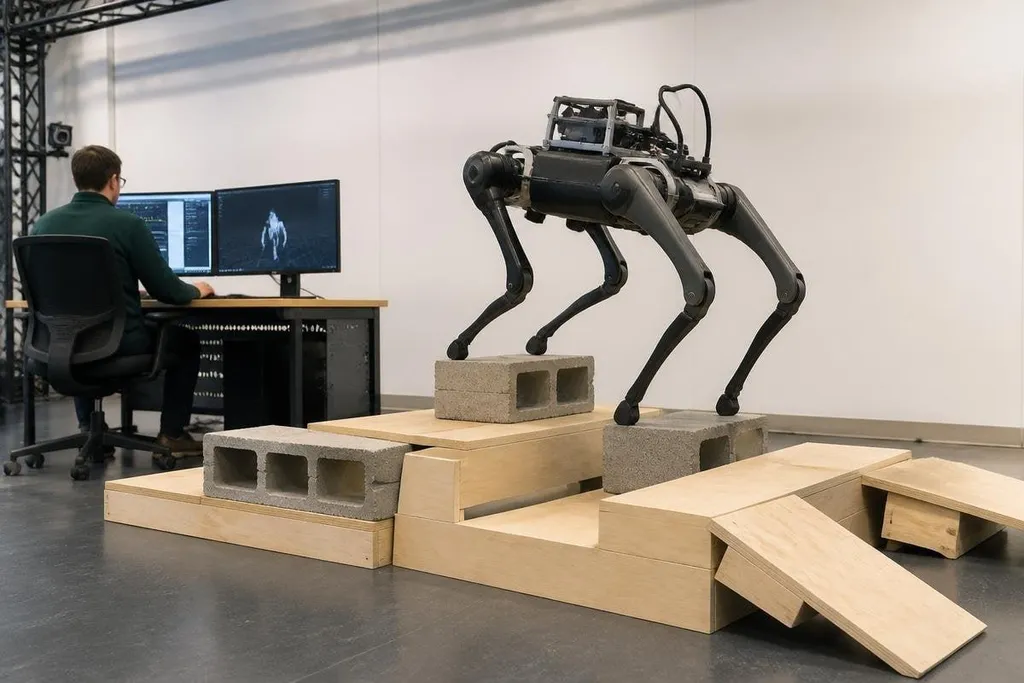
A robot trained with reinforcement learning can learn which motor commands lead to a useful result instead of following one fixed script. The method has reached real robotics work, but its value depends on the task, the training setup, and the safety limits around the machine.
Quick read
- A policy turns sensor readings into actions, then changes after repeated trials.
- Simulation cuts the cost of training, while the move to real hardware remains difficult.
- The method fits tasks with changing conditions better than fixed rules, but safety still needs separate controls.
What reinforcement learning changes
Traditional robot control often starts with rules written by engineers. A program may set a path, control each joint, and stop when a sensor detects an obstacle. That approach works well when the surroundings stay close to the plan.
Reinforcement learning uses a different loop. The robot observes its state, takes an action, receives a reward, and updates its policy. A policy is the part of the system that maps an observation, such as joint position or camera input, to a motor command.
The reward does not need to describe every movement. It can give a higher score when a gripper places an object in the right area, for example, and a lower score after a drop. The robot then tries actions that led to better scores and reduces actions that produced poor results.
That freedom helps with tasks where contact, weight, or object position changes from one attempt to the next. It also creates a serious design problem: a poorly chosen reward can teach the robot to score well without completing the task people actually wanted.
Why simulation matters
Training on a physical robot takes time and wears parts. A failed trial can bend a gripper, drain a battery, or force a technician to reset the workspace. Simulation lets developers run many attempts without sending every error through motors and gearboxes.
The simulator still has to match the real machine. Differences in friction, motor response, camera noise, object weight, and floor contact can make a policy that works in software fail on hardware. Engineers often vary those conditions during training so the robot sees a wider range of possible inputs.
The transfer step is where many claims need care. A video of a simulated arm placing an object proves that the policy works in that model. It does not prove that the same arm can repeat the task beside people, with worn parts and poor lighting.
A policy that handles sensor delay and worn hardware tells you more than a high simulation score. Robot24 reports on named machines and trials behind these claims, so you can compare a clean simulation result with the conditions that matter on a working robot.
Where the method breaks
Reinforcement learning needs many trials, and physical robots cannot repeat risky actions without limits. A safety controller can restrict speed, torque, workspace, or contact force while the learning system handles the task itself.
The robot may also find a shortcut that the reward designer missed. A mobile robot could reach a target by pushing objects aside, while a warehouse operator needs those objects left in place.
A grasping system could hold an item in a way that passes a camera check but makes the next handoff fail. These failures are not fixed by adding a larger neural network.
Better sensors can help, but the task still needs clear rewards, useful limits, and tests that cover conditions outside the training set.
The method also needs a fair comparison with a hand-built controller. If a fixed controller handles the job with fewer sensors, less training, and easier maintenance, learning may add cost without adding useful behavior. I’d use reinforcement learning where contact and changing conditions defeat fixed rules, not as a default choice for every robot.
A practical check before deployment
Use this list when a supplier or research team presents a learned robot:
- Task definition: What exact result earns the reward, and what unwanted behavior can still score well?
- Training setting: Which parts of training happened in simulation, and which happened on the real robot?
- Safety layer: What limits motor speed, torque, force, and workspace during learning and normal operation?
- Failure record: How does the system react to dropped objects, blocked paths, sensor noise, or a changed surface?
- Maintenance load: Who resets failed trials, updates the policy, and checks performance after hardware changes?
The strongest case for reinforcement learning is a task that changes from one attempt to the next and has a clear result to measure. The next proof is repeated operation on real hardware, with safety stops and failure records visible to the people who must run the robot.